Australian Lowline Cattle — Breed Information, History & Identity
Australian Lowline is a distinct registered cattle breed with a documented history, a closed herdbook and DNA-verified ancestry tracing back to the original Foundation Herd in Australia.
Yet the name Lowline is now used widely — and not always accurately. Terms such as “Lowline Angus” can make it difficult for farmers, breeders and cattle buyers to understand exactly what they are looking at.
This page explains where the Australian Lowline came from, what the breed name means, how registered Australian Lowlines differ from cattle simply described as Lowline, and why pedigree, registration and performance are separate — but equally important — considerations.
What is an Australian Lowline?
The Australian Lowline is a distinct beef cattle breed developed in Australia from cattle maintained in a closed research herd at Trangie, New South Wales.
The breed emerged from long-running Australian government research into the relationship between growth rate, mature size and beef production. When the research programme ended, cattle from the smallest selection line became the foundation of the breed now known as Australian Lowline.
Today, registered Australian Lowlines have a documented pedigree tracing back to that Foundation Herd. DNA parent verification and the closed herdbook protect the identity and integrity of the breed.
Australian Lowline is the registered breed name. Lowline is its accepted abbreviated name.
The importance of the name
The following article was written by Julie Knight and is retained here because it clearly explains the history and importance of the Australian Lowline name. Written at a time when the breed’s identity was increasingly being confused by alternative terminology, it remains a valuable explanation of why getting the name right matters.
'Australian Lowline'
Why is it so important we get it right?
It has been suggested by a few breeders of Australian Lowline cattle that the name ‘Lowline’ should be changed, as has been done in the United States of America and is currently being debated in Canada.
By changing the name of a breed, you lose the identity that has been established over years of promotion and marketing by dedicated members of our Association. A name change would lead to confusion within the membership and among the public, as has happened with a few other cattle breeds that have changed their name over recent years.
Anyone suggesting a name change for the breed reflects a lack of breed knowledge, history and understanding of the registered breed, Australian Lowline, which has been allocated the International Breed Code of AL.
AUSTRALIAN LOWLINE is the breed of cattle we all have and hopefully you are as passionate about them as I am.
But what is a breed?
The Oxford Dictionary says it is “a stock of animals or plants within a species having a distinctive appearance and typically having been developed by deliberate selection”.
How very apt is that definition when you consider the history of the Australian Lowline breed.
The name ‘Lowline’ is specific to the reasons behind the establishment of the breed in Australia.
Our breed descends from animals selected and developed in a breeding group called Low Line during trials which began in 1974. These trials based at the Agricultural Experimental Station in Trangie, New South Wales were collectively named ‘Implications of Selection for Growth – Trangie Cattle Project’ and were commissioned by the Australian Meat and Livestock Research Development Corporation. Data was compared between three individual groups of Angus animals over a 15-year period – the High Line, Control Line and Low Line groups.
The Foundation animals in our ALCA Herd Book trace back to those cattle in the Low Line group and indeed, can be traced further back in the Angus Herd Book to the original Aberdeen Angus imported to Australia in 1929.
Remember that by registering your cattle, you are preserving those pure genetics in a Herd Book that is unsurpassed by any other country breeding these genetics, under whatever name they are calling them. The ALCA Herd Book is the Foundation for the breed.
The ALCA Trademark
The Australian Lowline Cattle Association trademark of the three different sized bulls denotes the three trial groups, with the smallest representing the Lowlines.
The design was used for the final report for the Trangie trials and permission was given to Ian Pullar, the founding ALCA President, for the new Association to use as their logo. With the word ’LOWLINE’ added underneath the three silhouetted bulls standing on grass, this design was registered as the Trademark Logo for the Australian Lowline Cattle Association in 1999.
This unique logo represents the history of the breed and is widely recognised as the identity of Australian Lowlines. Maintaining a standard recognisable logo is one of the solid foundations of an Association over time.
The Lowline Logo is for the exclusive use of ALCA members for their own breed promotion for the duration of their membership. However, this privilege ceases when the membership is discontinued.
As a registered trademark, the Lowline Logo may be used provided there is no alteration to the original design, including the font, and the conditions for use is spelt out in the ALCA Constitution. The Lowline Logo is legally owned by the Association so misrepresentation or misuse of the logo can be contested by ALCA.
Why is using the correct breed name so important?
Simply, it is the only way to build breed awareness and marketplace recognition. Using the correct name links the animal with those traits and breed standard by which the breed is known. The Australian Lowline owners are responsible for the information the public receives about the cattle breed.
Australian Lowline is the breed name given to these cattle by the men who recognised the potential of the animals and in a way is a nod to those Trangie researchers and to the heritage and history of the breed. It is the name which represents all the amazing breed attributes, traits and genetic purity that we have grown to love in our cattle.
Australian Lowlines are descendants of the Aberdeen Angus cattle of yesteryear. They are very different to the modern Angus and exhibit none of the inherited genetic problems, nor the fertility, size and calving issues. The genotype & phenotype of modern Angus are very different from that of the Australian Lowline.
By using the incorrect breed name, such as ‘Lowline Angus’, you the breeder, are telling the marketplace that these cattle are not pure but are in fact a crossbreed (Lowline x Angus). You have just undermined the genetic purity, breed traits and advantages that you try so hard to promote. You have also denied their distinctive heritage and ancestry and inflicted maximum damage on the valuable registered counterparts, where the value is in the pure genetic lineage.
The fact that our Lowline cattle are DNA typed and Parent verified before registration and having a closed Herd Book where no unverified animals can be added, has resulted in a line of pure Aberdeen Angus cattle now named ‘Australian Lowline’. They can be traced back to the origins of the breed in Canada and Scotland – a rare fact in the cattle world of breed improvement by ‘breeding up’ and ‘genetic crossbreeding’. Very few breeds today can trace their heritage through a closed Herd Book back to their origins.
Using the correct name ensures more people will recognise this breed as AUSTRALIAN LOWLINE, or LOWLINE when abbreviated. ‘Australian Lowline’ and ‘Lowline’ are both official names for the breed we treasure and are in fact the only names that should be used.
Remember the reasons you chose to become involved with this unique beef breed and be proud of their heritage and history and do them justice by using the correct name – AUSTRALIAN LOWLINE.
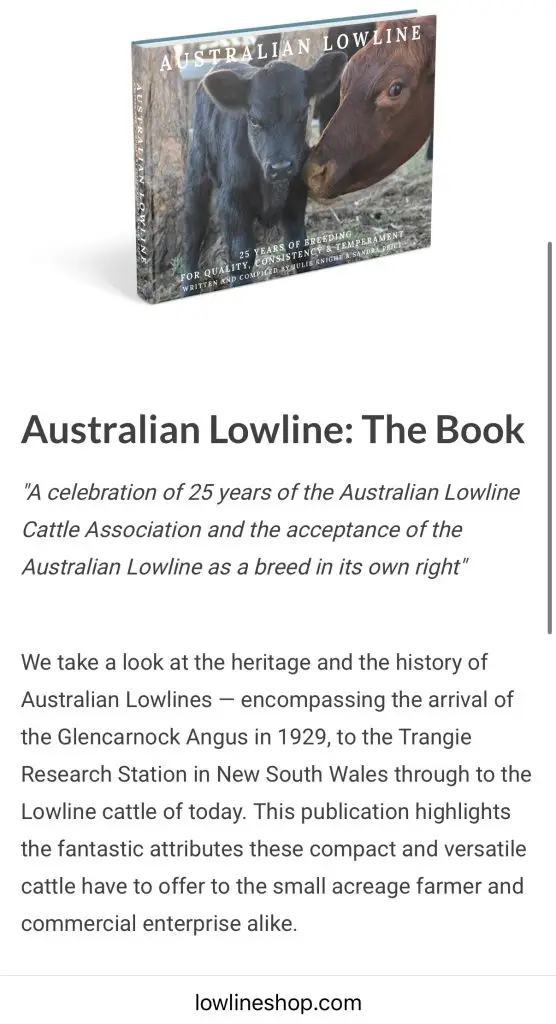
Further historical and general information about Australian Lowlines can be found in the commemorative Australian Lowline Book available through the Lowline Shop. www.lowlineshop.com
Julie Knight
Wanamara Farm, Victoria AUSTRALIA
Past ALCA President and Life Member
Australian Lowline, Lowline and “Lowline Angus” — what’s the difference?
Australian Lowline is the official registered breed name. Lowline is the accepted abbreviated name for the same breed.
“Lowline Angus” is not the registered breed name. The term is widely used in advertising and everyday conversation, but it can describe cattle of differing backgrounds and should not be assumed to mean a registered Australian Lowline.
This distinction matters because registered Australian Lowlines belong to a closed herdbook and have documented ancestry tracing to the Australian Foundation Herd. Registration and DNA parent verification provide traceability and establish breed identity.
Cattle described simply as “Lowline”, “Lowline Angus” or “Lowline cross” in the general marketplace may or may not have that same documented ancestry. The description alone cannot establish their registration status or breeding.
For anyone buying cattle, semen or embryos, the simplest approach is to ask: Is the animal registered as an Australian Lowline, and can its pedigree and registration be verified?
Does registration guarantee quality?
No. Registration establishes an animal’s breed identity, pedigree and traceability. It does not, by itself, guarantee that the animal will be fertile, structurally sound, productive or commercially useful.
Like any cattle breed, Australian Lowlines vary between individuals and genetic lines. Growth rate, mature size, fertility, calving performance, feet and leg structure, temperament, maternal ability and carcase characteristics all matter when deciding whether an animal should contribute to the next generation.
This is why responsible breeding requires more than maintaining a pedigree. Animals need to be assessed on what they actually do and, where possible, supported by objective performance records.
Pedigree tells us what an animal is. Performance tells us what it can do.
Why were Australian Lowlines developed?
Australian Lowlines were not originally developed simply to create a small breed of cattle.
Their origins lie in a major research programme begun at the Trangie Agricultural Research Centre in New South Wales in 1974. Researchers wanted to investigate the effects of selecting cattle for different growth rates and, importantly, whether larger or smaller animals differed in their efficiency of converting grass into beef.
Cattle from the closed Trangie herd were divided into three groups according to yearling growth rate: a High Line, a Low Line, and a randomly selected Control Line. The research went far beyond measuring size. Weight gain, feed intake, reproductive performance, milk production, carcase characteristics and structural soundness were among the traits evaluated.
Over successive generations, selection created a substantial difference in mature size between the High and Low Lines. After about 15 years, the Low Line cattle were approximately 30% smaller than the High Line cattle.
When the research programme eventually ended, cattle from the Low Line were released from Trangie. Purchasers of those cattle went on to establish the Australian Lowline Cattle Association, and in 1992 Australian Lowline became the officially registered breed name.
Are Australian Lowlines miniature cattle?
Australian Lowlines are naturally smaller cattle, but describing the breed simply as “miniature” misses much of the story.
The original Low Line cattle became smaller as a result of selection for lower yearling growth rate during the Trangie research programme. When the breed was established, small size became one of its most recognisable characteristics, and early promotion of Australian Lowlines placed considerable emphasis on cattle being “small” or “little”.
The way the breed is described has evolved. Today, moderate frame is a more useful description because it places size in the context of a functional beef animal rather than making smallness the breeding objective itself.
The current Australian Lowline breed standard does not prescribe a maximum or target height. Instead, it describes Australian Lowlines as traditionally moderate in frame and places importance on beef conformation, soundness and functionality.
This distinction matters. Continually selecting for smaller cattle does not necessarily produce better cattle. Growth, fertility, structural soundness, maternal ability, temperament and the capacity to produce quality beef remain fundamental considerations.
Australian Lowline is a beef breed. Moderate size is a characteristic — not a performance objective in itself.
How can you verify an Australian Lowline?
A registered Australian Lowline should have an individual identity and pedigree recorded with the relevant breed registry. That record provides the link back through successive generations to the Australian Lowline Foundation Herd.
Registration is the starting point. A prospective buyer should be able to ask for the animal’s registered name or identification and verify its pedigree through the breed registry.
DNA parent verification provides another important layer of integrity. It confirms that the recorded parentage is consistent with the animal’s DNA and helps protect the accuracy of the herdbook from one generation to the next.
It is important, however, to understand what DNA verification proves. It verifies parentage — it does not measure the quality or performance of the animal. Fertility, growth, mature size, structure, temperament, maternal performance and carcase traits must still be assessed separately.
Appearance alone is also not proof of breed identity. An animal may look like an Australian Lowline, but without documented pedigree and registration its ancestry cannot be established simply by looking at it.
For someone considering Australian Lowline cattle, semen or embryos, three separate questions are therefore useful:
Can its identity and pedigree be verified?
Is its parentage DNA verified where required?
Does its performance and functionality suit the purpose for which it is being selected?
What should you look for in an Australian Lowline?
An Australian Lowline should first and foremost be a functional beef animal.
Individual cattle will vary in size, type and breeding, but the fundamentals of sound beef production remain the same. Cattle should have adequate growth and capacity, good muscling, sound feet and legs, and the ability to move freely and comfortably.
Fertility is fundamental. Females should conceive reliably, calve successfully, rear a calf and return to breeding. Bulls must be fertile, structurally sound and capable of working effectively.
Temperament also matters. Cattle that are calm and manageable are safer to handle and better suited to practical farming systems.
Carcase characteristics are equally relevant. Australian Lowlines are beef cattle, so muscling, fat cover, meat quality and the ability to reach a useful finished weight should form part of any assessment of breeding merit.
No single trait should dominate selection. Extreme emphasis on size — whether breeding cattle progressively smaller or simply pursuing greater size — can come at the expense of other important characteristics.
The most useful Australian Lowline is therefore not necessarily the smallest, the largest, or the animal with the most impressive pedigree. It is one that combines breed identity with fertility, soundness, productive capacity and the ability to perform the job for which it is being bred.
Australian Lowline Cattle — Frequently Asked Questions
Is an Australian Lowline the same as an Angus?
Australian Lowline is a distinct registered cattle breed with its own closed herdbook.
Australian Lowlines have historical Angus ancestry. Their foundation cattle descended from Aberdeen Angus cattle imported into Australia and maintained within the Trangie research herd. That herd was closed to outside genetics in 1964, and the Low Line cattle that eventually founded the Australian Lowline breed came from within that closed population.
This ancestry explains the strong Angus characteristics of Australian Lowlines, but today Australian Lowline and Angus are separate registered breeds.
Is “Lowline Angus” a recognised breed?
The recognised breed name is Australian Lowline, with Lowline commonly used as its abbreviated name.
“Lowline Angus” and “Angus Lowline” are informal descriptions that are used inconsistently. Depending on the seller, they may refer to registered-origin but unregistered cattle, crossbred cattle, or simply cattle being described by their appearance or perceived ancestry.
The term itself therefore does not establish breed identity, pedigree or registration status. If certainty matters, the animal’s registration and pedigree should be verified rather than relying on the description used in an advertisement.
Are all cattle called “Lowline” registered Australian Lowlines?
No. The word “Lowline” by itself does not prove that an animal is registered.
Lowline is the accepted abbreviated name for Australian Lowline, so registered breeders quite correctly use it in everyday conversation. However, the term is also widely used in the general cattle marketplace for unregistered and crossbred animals.
Registration provides the documented pedigree that connects an animal to the Australian Lowline herdbook. Without that documentation, a description such as “Lowline”, however genuine the seller’s belief may be, cannot by itself establish the animal’s registered breed status.
If breed identity is important, ask for the registration rather than relying on the description.
Are Australian Lowlines naturally polled?
Yes. Australian Lowlines are naturally polled cattle.
The breed descends from the polled Angus cattle maintained within the Trangie research herd, and the Australian Lowline breed standard describes cattle as naturally polled.
Horns are therefore not a characteristic of a registered purebred Australian Lowline.
What colours can Australian Lowlines be?
Registered Australian Lowlines may be black or red.
Black is the traditional and most common colour, while red Australian Lowlines also occur within the breed.
Under the Australian Lowline breed standard, colours other than black or red indicate that the animal is a cross and not a purebred Australian Lowline.
Colour itself, however, does not prove breed identity. A black or red animal still requires the appropriate pedigree and registration to establish that it is a registered Australian Lowline.
Are Australian Lowlines suitable for beef production?
Yes. Australian Lowlines are a beef breed, and beef production was fundamental to the research from which the breed emerged.
Their moderate mature size can suit grass-based production systems where fertility, stocking efficiency, ease of handling and the ability to finish cattle efficiently are important.
As with any breed, however, performance varies between animals and genetic lines. Mature size alone does not determine beef efficiency. Growth rate, fertility, carcase characteristics, structural soundness and the time required to reach a useful finished weight all need to be considered.
Australian Lowlines can also be used in crossbreeding programmes, where their moderate birth weights and beef characteristics may complement larger cattle.
The relevant question is not simply how small the animal is, but how efficiently it produces useful beef.
Further information and breed resources
Information about the history, registration, breed standard and pedigree requirements of Australian Lowline cattle is maintained by the Australian Lowline Cattle Association (ALCA), the official breed association responsible for the Australian Lowline herdbook.
Australian Lowline Cattle Association
Breed history, information, registration and herdbook
Australian Lowline Breed Standard
The current breed standard is contained within the ALCA Constitution and Regulations and describes the recognised characteristics and requirements of registered Australian Lowline cattle.
Australian Lowline: The Book
Published to commemorate 25 years of the Australian Lowline Cattle Association, this book records the history of the cattle, the Trangie research programme and the development of Australian Lowline as a recognised breed.